Although historians have done tremendous work in bringing the University’s history of slavery to light after the discovery of enslaved remains, there has not been an analysis of the overall racial histories intertwined with the University.
Incorporating the history of the people native to a settler land is a methodology of the settler-native-slave triad, which has been done by scholars in Black, African American, Indigenous, Native studies, and Feminist and Gender Studies. A scholar under the pseudonym la paperson views the triad through each person's relationship to land: “the settler who accumulates rights, land, and property; the native whose presence on land must be extinguished; the chattel slave who must be kept landless” (2017, 8). Here I apply my own feminist view - of non-dominant histories and peoples - to view the intersectional racialized histories of UGA and Baldwin Hall specifically through the triad.
UGA and Native American History
Native and Indigenous Studies generally argues that the U.S. public is typically told to forget about the history of people indigenous to the United States, that the only people worthy of being known were those who interacted with Western explorers and settlers, and that there was a finality to the interactions between these groups (Vimalassery et. al. 2016), but interrogating the early days of UGA visibilizes the integral role UGA played in furthering settler colonialism.
Red and Black newspaper articles in 1961 describe how the Old College building at UGA was used as a fortress for settlers when Indigenous groups attacked Athens and that UGA’s tradition of the sheriff marching before students at graduation is because a sheriff marched before students at UGA’s first graduation in 1805 to protect them from a possible “Indian attack” (Cullom 7, Cheney 1). Historian Walter-Reed credits the sixteen years between chartering and officially beginning the university as a time where the founders were lazy and slow to organize, but a letter written by Abraham Baldwin - the first president of UGA - shows how his plans for a new location were thwarted by the imminent arrival of the Creek nation (Reed 28, Baldwin). These sources prove that settler colonialism was still taking place even after the University of Georgia was founded and began classes, and Cherokee and Creek tribe-members were consistently resisting settler colonialism.
The Petroglyphic Boulders
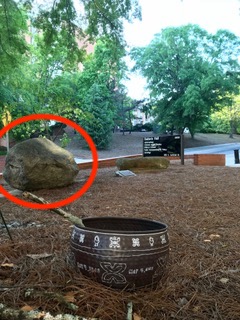
Petroglyphic Boulders circled in red at Baldwin Hall site, next to the libation urn from the 2017 Day of Jubilee Celebration. Image taken by Laura Brannan, 2017.
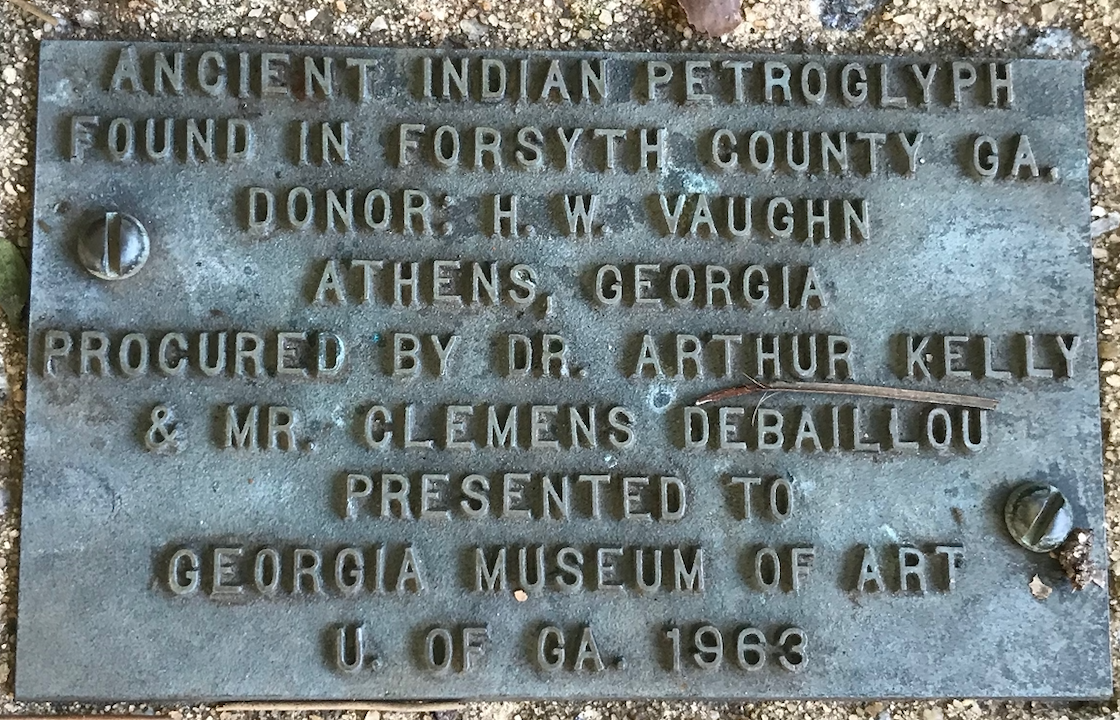
Plaque on Petroglyphic Boulders at Baldwin Hall
Site. Image taken by Laura Brannan, 2017.
The above photos showcase the “Petroglyphic Boulders,” which are two boulders on the lawn outside of Baldwin Hall. Although we do not know how the general public initially interpreted the boulders when they were installed in 1963, a Red & Black article in 1974 implies that early viewers of the boulders interpreted the memorial with a neo-colonial fascination (Hunt 6). Seen in the verb choices throughout the article about the boulders and carvings “defying translation,” being “shrouded in mystery,” and opening with, “Nobody knows when they were carved, exactly where they came from, or what they mean," the journalist reproduces a neo-colonial mystification about how mysterious and unknowable the boulders are (Hunt 6). Because the carvings and boulders are undecipherable to the Western settlers who are studying it, the native is seen as so far outside of Western culture and therefore fetishized as a non-human “other.”
Today, most people do not even notice these boulders, as Professor of Native American Studies and Director of the History Department at UGA Dr. Claudio Saunt said he had never noticed or was even aware of the boulders at Baldwin Hall (personal communication). This and the above Red & Black articles show that UGA's complex history with indigenous people and whiteness has always been present, but perhaps in diffferent and more invisibilized ways than slavery. Indeed in a different sense, they are buried histories.